
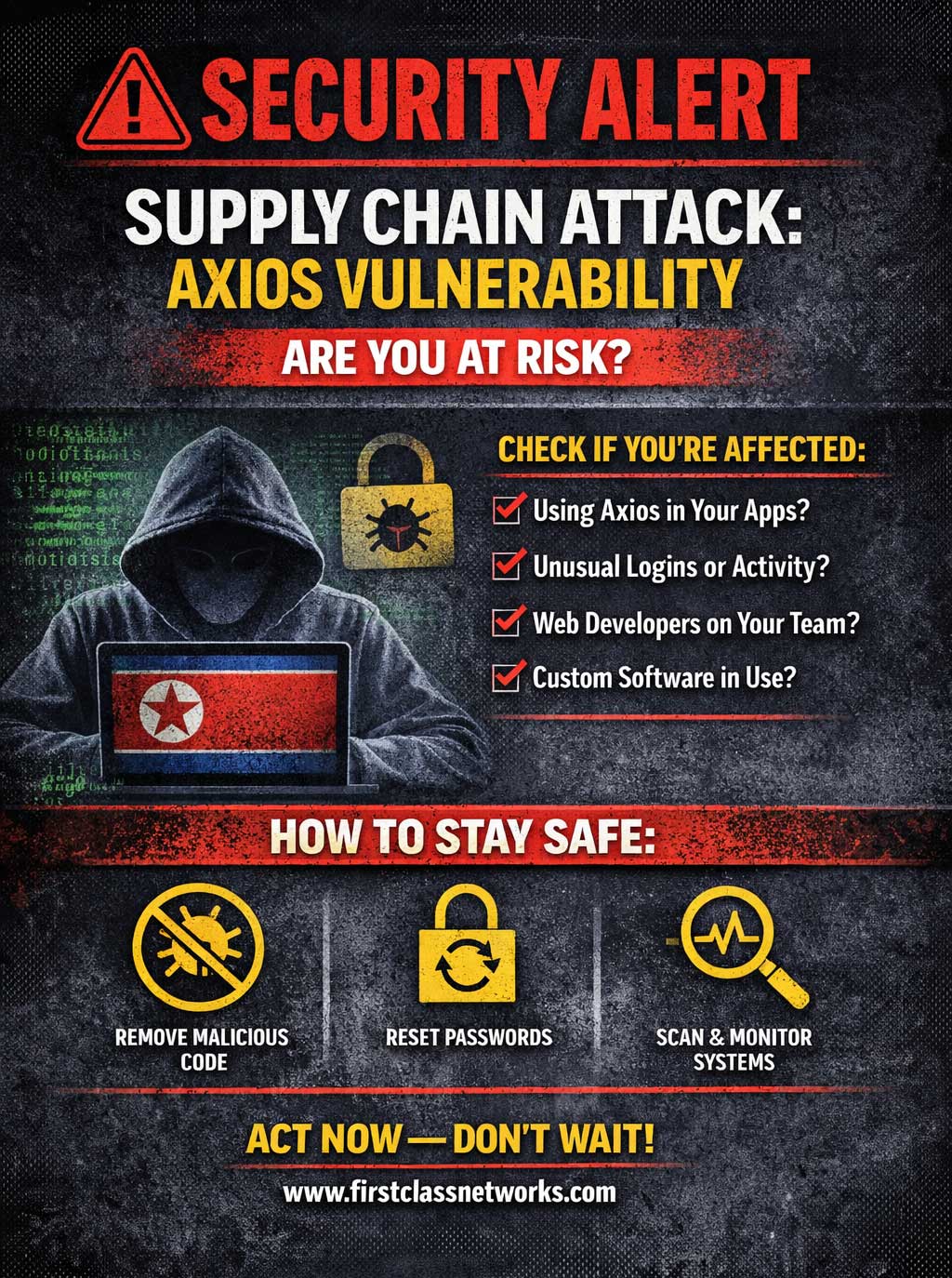
A new supply chain attack has been identified involving a serious Axios vulnerability, and it’s a reminder of how quickly trusted software can become a threat.
Attackers linked to North Korea inserted malicious code into a widely used software component, putting businesses at risk without any obvious warning signs.
For a deeper technical analysis, you can review the original report from Google here:
https://cloud.google.com/blog/topics/threat-intelligence/north-korea-threat-actor-targets-axios-npm-package/?mod=djemCybersecruityPro&tpl=cs
What matters most for your business is this:
This supply chain attack may already be inside systems without being detected.
What Is This Supply Chain Attack and Why It Matters
This incident centers around the Axios vulnerability, which was exploited through a compromised software update.
Instead of attacking users directly, attackers:
- Injected malicious code into a trusted package
- Distributed it through legitimate channels
- Gained access to systems that installed the update
This is what makes a supply chain attack so dangerous. It leverages trust instead of breaking through defenses.
How to Tell If You’re Affected by the Axios Vulnerability
If your business uses custom applications or relies on web-based tools, you should assume potential exposure until verified otherwise.
- Check If Your Environment Uses Axios
You may be affected if:
- Your business uses custom web applications
- You have internal or outsourced developers
- You run systems built with Node.js or modern web frameworks
Ask your IT team or vendor directly:
“Are we using Axios, and have we checked for the compromised versions?”
- Identify Potentially Compromised Installations
Your IT provider should:
- Review npm dependencies across your environment
- Identify any recently installed or updated Axios packages
- Validate package integrity and source authenticity
Timing matters. The malicious version was only available briefly, but widely distributed.
- Watch for Signs of Credential Theft
This Axios vulnerability was designed to steal login credentials.
Look for:
- Unusual login activity
- Unexpected MFA prompts
- Locked or compromised accounts
- Suspicious system behavior
- Verify Your Vendors Are Not Impacted
This is one of the most overlooked risks in a supply chain attack.
Ask your vendors:
- “Have you reviewed your systems for the Axios vulnerability?”
- “Can you confirm your software supply chain is secure?”
How to Remove the Threat and Secure Your Systems
If there is any chance your systems were exposed to this supply chain attack, act immediately.
Remove Compromised Software
- Uninstall affected Axios versions
- Reinstall clean versions from verified sources
- Avoid using cached or previously downloaded packages
Reset Credentials Across Your Environment
Assume credentials may have been exposed.
- Reset admin and user passwords
- Rotate API keys and service credentials
- Enforce strong password policies
Force Session Resets
- Log users out of all systems
- Invalidate active sessions and tokens
- Reauthenticate all integrations
Run Advanced Security Scans
Use endpoint detection and response tools to:
- Identify malicious processes
- Detect unusual outbound traffic
- Remove persistence mechanisms
Monitor for Ongoing Activity
Supply chain attacks often lead to delayed breaches.
Monitor for at least 30–60 days:
- Email account anomalies
- Financial system changes
- Unauthorized access attempts
The Bigger Risk: Supply Chain Attacks Are Increasing
The Axios vulnerability is not an isolated event.
We’re seeing a clear shift:
- Attackers targeting software instead of users
- Malware delivered through trusted updates
- Breaches that start silently and escalate later
This is the future of cyber threats.
Final Takeaway
This wasn’t caused by a mistake.
It wasn’t caused by weak passwords.
It was caused by trust in software that was compromised.
That’s why traditional security alone is no longer enough.
Concerned About Your Exposure to This Supply Chain Attack?
If you’re unsure whether your business is affected by the Axios vulnerability or similar risks, it’s worth taking a closer look.
We help businesses:
- Identify hidden exposure
- Strengthen defenses
- Stay ahead of emerging threats
👉 Start here: https://www.firstclassnetworks.com/contact-us/

